Technology

Why Off-the-Shelf Travel Scripts Are Killing Your Growth (And What to Build in 2025)

The hidden costs of $200 scripts vs. custom travel portal development. Learn why custom architecture protects your revenue.

AnantalabsAnantaLabs TeamMarch 08, 20266 min read
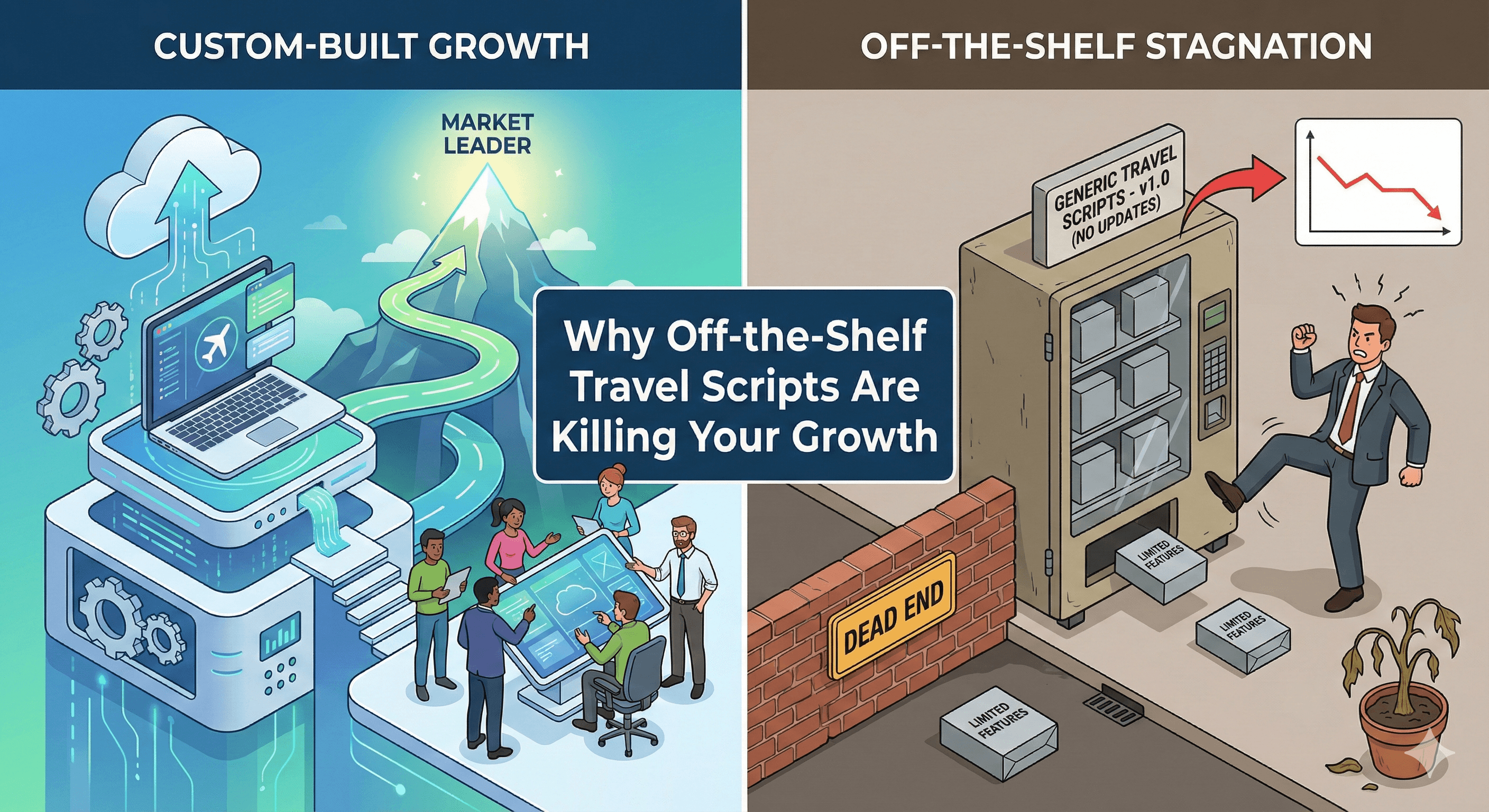
Comparison of cheap scripts vs custom travel tech architecture.

The Hard Truth About Ready-Made Scripts

It is the most common story in the travel startup world. You have a vision for a global travel agency. You search online and find a 'Ready-Made Travel Portal Script' for $200 or $500. It seems like a smart financial decision. Why pay an agency for custom development when you can buy it off the shelf? Here is the hard truth: That script is not an asset; it is a liability. At AnantaLabs, we frequently onboard clients who have spent the last 6 months battling with these scripts. They usually come to us at the same stage: when they finally get some traffic, and the entire system crashes.

1. The Hidden 'Tech Debt' of Cheap Scripts

Most cheap travel scripts are built on outdated PHP frameworks with code that hasn't been updated in years. While they might look fine on a demo link, the backend is often a mess of 'spaghetti code'. Security risks are high; handling sensitive data like passport numbers on these scripts is dangerous due to SQL Injection vulnerabilities. Furthermore, inefficient polling methods slow down search results significantly. In 2025, if your search results take more than 3 seconds to load, 40% of your customers will leave.

  • Security Risks: High vulnerability to SQL Injection and data breaches.
  • API Rate Limits: Inefficient polling causes slow search results (e.g., 2+ minutes load time).
  • Performance: We found scripts making 70 unnecessary API calls per search.

2. The 'Scale Breakers': Why You Get Stuck

A script is a 'walled garden.' You can only do what the original developer decided you could do. As you grow, you will want features that the script doesn't support. Server load is another major issue; these scripts are rarely optimized for cloud hosting, causing database lockups during marketing campaigns.

  • Multi-Currency & Multi-Language: Often broken or hard-coded.
  • Inflexible Checkout Flows: Impossible to add custom upsells like insurance.
  • Server Load: Not built for high traffic or concurrent users.

3. What A Scalable Travel Stack Looks Like in 2025

If you are serious about building a travel aggregator or a B2B portal, you need a stack that separates the Frontend (what users see) from the Backend (the logic). At AnantaLabs, we move our clients away from monolithic scripts toward 'Headless' architectures. We recommend React.js or Next.js for the frontend to beat competition in search rankings.

  • Frontend: Next.js or React.js for speed and modern app-feel.
  • Backend: Node.js or Python for efficient API connections.
  • SEO Boost: A client saw a ranking boost just two weeks after migrating to Next.js.

4. The AnantaLabs Approach: Building for Revenue

We don't just write code; we build systems designed to get you bookings. We focus on creating a robust infrastructure that automates operations and optimizes costs.

  • Unified API Integration: Seamless connection to Amadeus, Sabre, Galileo, TBO, Duffel.
  • Smart Caching: Store results intellectually to save on API costs.
  • Automated Back-Office: Automated GST invoicing and markup management.

Conclusion

You have two choices. You can pay $500 now for a script and spend $10,000 fixing it later. Or, you can invest in a custom solution that belongs to you, scales with you, and offers your customers a world-class experience. Ready to upgrade your travel tech? Stop losing bookings to slow websites.

AnantaLabs Team

Author

AnantaLabs Team

Strategy & Insights

We craft resources that help ambitious brands launch faster, scale smarter, and stay ahead in digital.

Frequently asked questions

A specialized team ensures high-quality, scalable, and efficient solutions tailored precisely to your business goals.